Chai AI carries a 4.3 on the App Store from 279,000 ratings, a 3.6 on Google Play from 832,000, and a 2.5 on Trustpilot. Three different products by rating, one company.
Short version: the technology is more serious than the app store makes it look, and the 70-message free tier, the ad load, the memory that measurably collapses over a month, and a billing operation people describe in language usually reserved for scams explain why the gap between those numbers is so wide.
What Is Chai AI?
Chai is a social-AI chat platform built around roughly 500,000 user-made characters. Pick one, chat by text, or build your own. It runs on iOS, Android and a web client, and the pitch is explicitly “entertaining and social,” not “factually correct.”
It is mobile-first in a way its rivals are not. Swipe mechanics, chat bubbles, notifications, and a TikTok-style discovery feed for finding new characters — the whole thing is designed for a phone screen rather than ported to one. That is a genuine advantage, and it is why people keep opening it.
The company is Chai Research Corp, run by physicist and founder William Beauchamp. Behind the consumer app is a research organisation running the Chaiverse leaderboard, where third-party developers submit fine-tuned models that compete on real user-engagement metrics for cash prizes; winners get slotted into the app. Most consumer companion apps hide the model choice. Chai turned it into a public tournament.
On paper, impressive engineering. In the reviews, the story shifts hard.
Chai AI Pricing in 2026
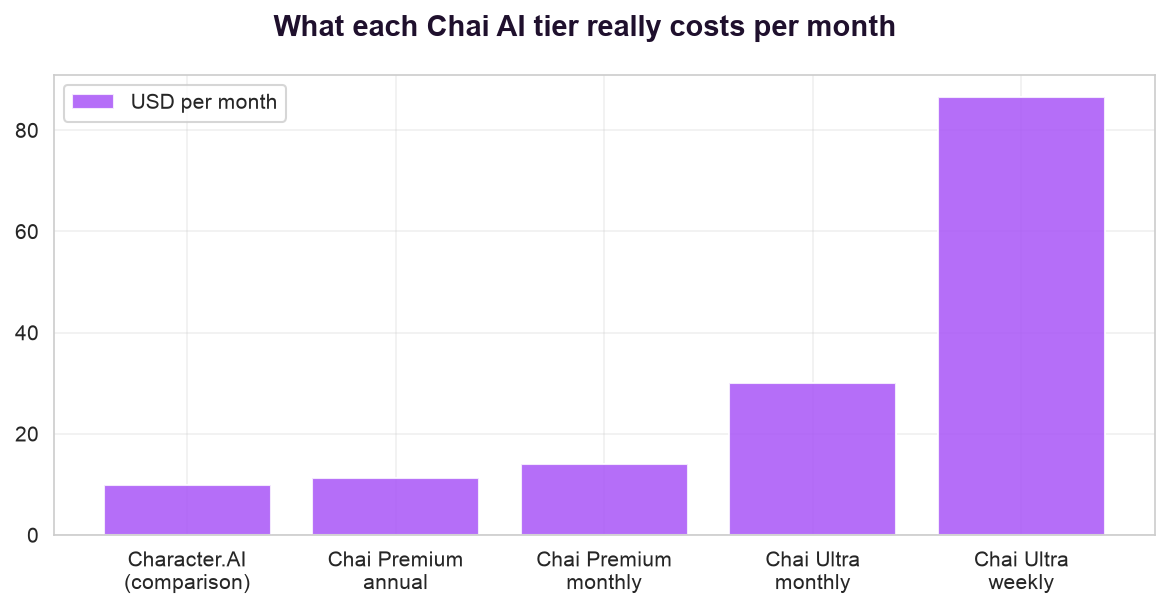
Every tier, current as of September 2026, from the App Store listing:
| Tier | Price | Cycle |
|---|---|---|
| Free | $0 | 70 messages per 2.5 hours, with ads |
| Premium Monthly | $13.99 | per month |
| Premium Annual | $134.99 | per year (≈ $11.25/mo) |
| Ultra Weekly | $19.99 | per week |
| Ultra Monthly | $29.99 | per month |
Plus an in-app currency called Pieces: 200 for $2.79, spent on image responses and generation boosters on top of whatever tier you hold.
Three things stand out.
Premium at $13.99 is priced above the category leader. Character.AI charges $9.99 for a better-regarded roleplay experience. Chai is asking a 40% premium while scoring lower on conversation quality in every comparative test I can find.
The Ultra Weekly at $19.99 annualises past $1,000. That is a shape you almost never see in a chat app. It is not an oddity either — reviewers tracking Chai over time describe weekly plans progressively displacing monthly ones, which is a monetisation pattern designed to catch impulse spend and make the true annual cost hard to compute.
Ads reappear on paid tiers. This shows up repeatedly in reviews from people who are already subscribed, usually around message boosters. Paying does not reliably end the nagging.
The Free Tier: 70 Messages, Then the Timer
The free allowance is 70 messages per 2.5 hours. In practice that is about twenty minutes of actual roleplay, after which you watch a countdown.
Around that cap, the pattern reviewers describe is consistent:
- Full-screen video ads between messages as you approach the limit.
- Ads that occasionally fire mid-conversation, breaking the exact immersion you opened the app for.
- Pieces prompts layered on top for image responses and boosters.
Premium removes ads and lifts the cap; Ultra targets heavy users who want no ceiling. The distance between free and paid is engineered to be wide enough that paying feels like relief rather than value — and that distinction matters, because relief-driven purchases are the ones people resent later.
The Billing Complaints Nobody Puts in the Headline
This is the part of Chai’s reputation that the star ratings compress into a single number, and it deserves unpacking, because it is the substance behind the 2.5 on Trustpilot.
Unauthorised micro-charges. The most serious recurring account describes saved payment credentials being used for rapid-fire small charges — one user documented over $122 drained this way. Small individual amounts do not trigger the scrutiny a single large charge would, which is precisely why the pattern is worth naming.
Cancellation designed to be difficult. Users report stacked retention screens and, specifically, cancellation controls rendered in very light text on a white background. That is not an accident of design; low-contrast text on the exit path is a recognised dark pattern.
Refund requests going unanswered. Multiple reviewers describe writing to support and receiving nothing back.
I want to be precise about the weight here: these are user reports on a review platform, not findings from an investigation, and the population writing them self-selects for people with a billing grievance. But there are enough of them, consistent enough in shape, that anyone about to enter card details should know the pattern exists. If you subscribe, do it through the App Store or Play Store subscription system rather than any in-app card form — store-mediated subscriptions give you a cancellation path and a refund route that the vendor does not control.
The Ratings Divergence
App-store ratings and Trustpilot measure different populations, and Chai is a clean case study in what that produces.
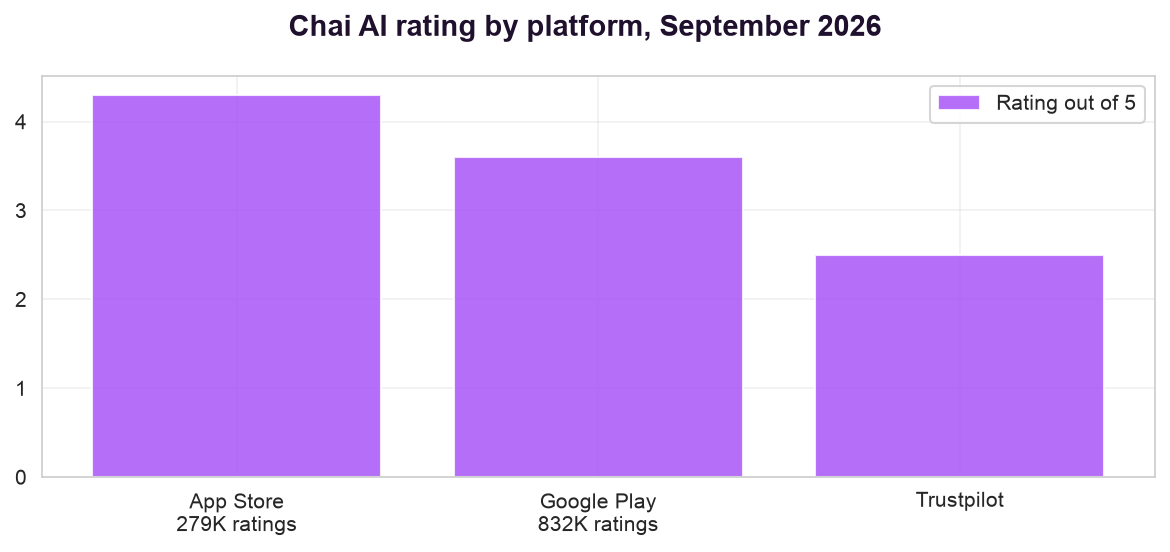
iOS 4.3 from 279K is inflated by in-app rating prompts that fire during positive interactions — you are asked to rate at the moment the app is working.
Google Play 3.6 from 832K is a far larger sample, a different demographic, and an ad experience Play’s guidelines permit that iOS restricts. At three times the sample size, it is the closest thing to a median-user signal.
Trustpilot 2.5 is the smallest sample and self-selects hardest — but as the section above shows, it is not selecting for people with vague dissatisfaction. It is selecting for people with billing disputes. A low score built from that is a different signal than a low score built from “I didn’t like the vibe.”
Read together: casual users are fine, heavy users are frustrated, and paying users are the angriest cohort of all. That ordering is unusual and it is the single most informative thing about the app.
Is Chai AI Safe?
Two questions live inside “safe”: is the company legitimate, and is the product safe to use.
As a company, Chai Research Corp is a real entity with named leadership, a research arm and standard store presence. It publishes terms and a privacy policy. The billing complaints above sit alongside that, not against it.
As a product, three concrete weaknesses:
- No end-to-end encryption. Your conversations are technically readable by the system and by staff. For a product whose entire use case is intimate conversation, that is a meaningful gap.
- No meaningful age gate. The app is rated 18+ but registration does not verify anything. Anyone can sign up. The rating is a label, not a gate.
- No clear data-deletion path. Uninstalling removes the app. Reviewers report no evident process for permanently erasing chat history or account data.
And the harder part: in March 2023 a Belgian man died by suicide after weeks of intensifying conversations with a Chai character named Eliza. The case was widely reported and Chai responded by adding a crisis-intervention message. Reports of intense attachment and of characters going off-script into harmful territory have continued since.
If you want uncensored roleplay, Chai does not promise it. If you want something genuinely safe for a teenager, the absent age gate means you cannot rely on the 18+ label to provide it.
Why Is the Chai App 18+?
Both stores rate it 18+ because the content warrants it. Apple’s listing flags frequent profanity and mature themes, plus infrequent sexual content, violence, horror, drug references and weapons — a longer list than most companion apps carry.
Two things drive it:
- User-made characters run on weaker guardrails than a company-authored persona. You are not talking to Chai; you are talking to something a stranger built and named.
- Moderation is uneven in both directions. Content that should be blocked sometimes is not — reviewers note that even with filters enabled, bots produce suggestive material inconsistently. Content that should not be blocked routinely is, which is the source of the false-positive complaints about ordinary words.
The 18+ tag is the correct rating for what you will encounter. It is just not enforced by anything.
Does Chai AI Read Your Chats?
Yes, in four distinct senses people tend to conflate.
One: Chai uses conversation data to train and improve models. Disclosed in the privacy policy, standard across the category.
Two: there is no end-to-end encryption, so messages are stored in a form the company can read. Not unusual for this category, but worth stating plainly rather than assuming.
Three: character creators can see conversations with their public characters. This is the single most-cited privacy complaint on the App Store, and users routinely discover it only after the fact. Characters you build privately are not visible to anyone else; someone else’s public character means its creator can read what you wrote to it.
Four: moderation systems read messages to run the filter. That filter is the source of the false-positive problem — ordinary vocabulary in an ordinary scene gets flagged, blocked or silently shortened.
Add the missing deletion path and the picture is: everything you type is retained, readable by more parties than you expected, and not straightforwardly removable.
The Memory Problem
This is the most-repeated substantive complaint, and unlike most such complaints it has been measured. In structured recall testing across 2,147 messages, Chai scored 6 out of 12 on one-day recall and 2 out of 12 at one month.
That matches what users describe: ten to fifteen exchanges in, characters start losing names, established facts, and the setting itself. Premium and Ultra extend context, but the ceiling is architectural — the system is optimised for engagement volume, not persistence, and a larger buffer does not change that. The bluntest version of this complaint appears verbatim in reviews: you pay the Ultra price for memory and it still does not remember.
If you want a companion who recalls your birthday next month, Chai is not the shape of app that provides one.
What Chai Gets Right
- A real research operation. Chaiverse is a genuine model-selection tournament, and it is why chat quality has improved measurably across releases.
- Mobile execution. Built for a phone, not ported to one. The discovery feed is genuinely good at surfacing characters you would not have searched for.
- Character variety at scale. ~500,000 user-made characters with the community energy Character.AI used to have.
- The filter is looser than Character.AI’s. Inconsistent, but it interferes less often with ordinary roleplay — which is exactly why many Chai users arrived from Character.AI.
What Chai Gets Wrong
- 70 messages per 2.5 hours is about twenty minutes, and the countdown is the product’s main persuasion mechanism.
- Ads reappear on paid tiers, which undercuts the core reason to pay.
- Memory measurably collapses — 2/12 at a month — and no tier fixes it.
- The filter is inconsistent in both directions, heavy on innocuous words and permissive where it should not be.
- Creator visibility into public-character chats is a real privacy issue most users find out about too late.
- No E2E encryption, no age gate, no deletion path — three gaps that each individually would be defensible and together are not.
- The billing reports — micro-charges, low-contrast cancellation controls, unanswered refunds — are the most serious thing on this list.
- $13.99 against Character.AI’s $9.99 for a lower-rated conversation experience.
Verdict: 6/10
Interesting technology and a genuinely good mobile product, wrapped in a monetisation operation that generates the angriest reviews in the category.
Good fit: you want a wide character library and a looser filter than Character.AI, you like the discovery feed, and you will use it casually enough that the 70-message ceiling is an annoyance rather than the defining experience.
Poor fit: you want a companion who remembers you week to week, you are sensitive to aggressive monetisation, or you want NSFW roleplay without a filter that trips on ordinary words.
The 4.3 is what casual users tap. The 2.5 is what paying users write. Both are true, and the direction of that gradient is the review.
6 Chai AI Alternatives Worth Considering in 2026
No single platform wins here. Which fits depends on what Chai is failing at for you.
1. Kindroid — the structural answer to memory drift. Built around one persistent companion with long-term memory that actually holds. If your complaint is 2/12 recall at a month, this is not a tier upgrade, it is a different architecture.
2. SpicyChat — the same library-and-creation shape, cleaner tier ladder. Covered in full in our SpicyChat review. Comparable breadth, no ads on paid, deeper creation tools, and the entry tier is still under $6/month after the September pricing update.
3. Bonza.Chat — uncensored AI chat without the setup work. Built as an NSFW AI chatbot that works out of the box — no jailbreaks, no coin economy, no ads, and a straightforward cancellation path. Honest trade: the character library is curated rather than the half-million Chai carries, so if what you like about Chai is the endless discovery feed, you will feel the smaller catalogue immediately.
4. Character.AI — the largest library, at $9.99, if you can live with the filter. Bigger and better polished than Chai and four dollars cheaper, but its filter is considerably stricter. Most people migrating between the two start with our Character.AI alternatives round-up.
5. PolyBuzz — the closest like-for-like. Same mobile-first, huge-library shape as Chai with a more permissive filter and the same coin-and-tier logic, so read the monetisation carefully before switching — our PolyBuzz alternatives breakdown covers where it differs.
6. Muah AI — the fewest restrictions. Voice, images and permissive moderation in one product. Rougher interface, smaller catalogue, honest about what it is.
| Platform | Best for | Free tier | Ads on paid | Memory | Library |
|---|---|---|---|---|---|
| Chai | Casual variety, discovery | 70 msg / 2.5h | Occasional | Weak (2/12 at 1mo) | ~500K |
| Kindroid | One lasting companion | Limited | No | Strong | Small |
| SpicyChat | Cheap entry, deep tools | Ad-supported | No | Medium, tier-gated | Huge |
| Bonza.Chat | Fast, uncensored chat | Yes | No | Good | Curated |
| Character.AI | Sheer volume | Generous | No | Medium | Huge |
| PolyBuzz | Chai-shaped, more permissive | Coin-limited | Occasional | Medium | Large |
| Muah AI | Fewest restrictions | Limited | No | Medium | Medium |
Frequently Asked Questions
Is the Chai AI app safe? Safe as a company — Chai Research Corp is a real entity with a research arm and standard store presence. Safe as a product — with caveats. There is no end-to-end encryption, no meaningful age verification at signup, and no clear way to permanently delete your data. A 2023 case in Belgium ended in a user’s suicide after weeks of conversations with a Chai character. Treat it as adult entertainment, not therapy, and subscribe through your app store rather than an in-app card form.
Why is the Chai app 18+? Because the content genuinely is. Apple’s listing flags frequent profanity and mature themes plus infrequent sexual content, violence, horror, drug and weapons references. User-made characters run on weaker guardrails than company personas, and moderation is uneven enough that both extremes get through. Note that the 18+ rating is a label, not a gate — registration verifies nothing.
Does Chai AI read your chats? Yes, in several senses. Conversation data trains the models, there is no end-to-end encryption so messages are readable by the company, moderation systems scan messages to run the filter, and — the one that surprises people — creators of public characters can read conversations users have with their characters. Characters you build privately are not visible to others.
Is Chai AI completely free? No. The free tier is 70 messages per 2.5 hours with ads, which is roughly twenty minutes of use. Premium is $13.99/month or $134.99/year. Ultra is $19.99/week or $29.99/month. Even paid users report ads around message boosters.
How much does Chai AI cost? Premium $13.99 monthly or $134.99 annually; Ultra $19.99 weekly or $29.99 monthly; Pieces currency at 200 for $2.79. For comparison, Character.AI is $9.99/month.
Why do the ratings disagree so much? Different populations. App-store ratings are driven by in-app prompts that fire during good moments. Trustpilot self-selects for people with a billing dispute, which is what its reviews are mostly about. Google Play, at 832K ratings, is the largest sample and sits between them at 3.6 — the closest signal to a median user.
Does Chai AI remember conversations? Poorly. Structured recall testing put it at 6/12 after one day and 2/12 after a month. Paid tiers extend the context window but do not fix the underlying design, and “paid for Ultra, still forgets” is a recurring review theme.
What are the best Chai AI alternatives? Depends on the complaint. Kindroid for the memory problem, SpicyChat for cheaper entry and deeper tools, Bonza.Chat for uncensored chat that works without setup, Character.AI for the largest library at a lower price, PolyBuzz for the closest like-for-like, Muah AI for fewest restrictions.