Nastia AI has four public scores, and no two of them agree.
Its own homepage declares 4.8 out of 5 from 12,000 ratings. An affiliate blog says 4.3 with “over 72% positive user reviews.” The top Reddit thread for the search term is one user’s write-up titled “TLDR it’s 3.6 stars.” And Trustpilot shows 2.1 — “Poor” — from 16 reviews, 75% of them one star.
A 2.7-point spread on a five-point scale is not a rounding difference. It means four different things are being measured and printed as if they were one thing.
So this review goes to primary sources. Pricing comes from Nastia’s own live plan table, token costs from the developer’s changelog, company details from the French business registry. One limit up front: Reddit returned 403 to every request we made, so every Reddit line below is quoted from Google’s index excerpt of the thread, never from the thread itself. Threads are linked so you can open what we could not.
Short version: the product is better than Trustpilot suggests and worse than its own structured data claims, the pricing is confusing in a way that explains most of the billing complaints, and the memory problem everyone quotes was rebuilt in February 2026 — after most of the complaints were written.
What Is Nastia AI?
Nastia is an uncensored AI companion platform for adults — text chat, voice messages, image and video generation, and group chats with several companions at once. It runs in the browser, with no app-store listing, which is why there are no App Store or Google Play ratings to compare against.
Its homepage pitches it against ChatGPT and Character.AI: “Nastia is built for NSFW chat, dirty talk, and steamy adult roleplay.” The site carries 17 “alternative to X” pages — Character.AI, Replika, Candy AI, SpicyChat, Chai — so the acquisition strategy is aimed at people leaving filtered platforms. If that’s you, our round-up of AI girlfriend apps with no filter covers the wider field.
The operator is Nastia Cybernetics, a French SAS registered 1 November 2023, SIREN 982046385, based in Saint-Laurent-du-Maroni, French Guiana. The registry lists one director — Melvyn Fowell, born 1998 — and one establishment; the employee-count band is not disclosed.
Where Each of the Four Numbers Comes From
This is the part every other review skips.
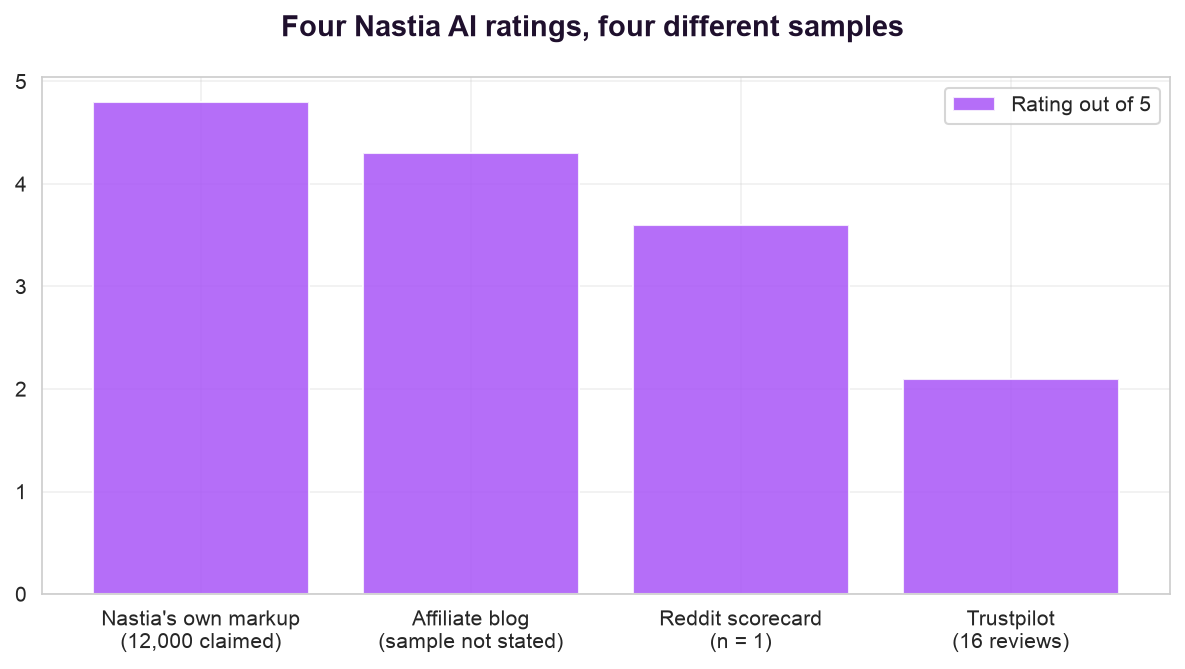
The 4.8 lives in a SoftwareApplication block on Nastia’s homepage — “ratingValue”: “4.8”, “ratingCount”: “12000” — with no rating widget on the page and no source given. Worth understanding rather than getting worked up about: self-declared ratings in structured data are near-universal in this category, ours included. Google’s own review snippet guidelines ask that such ratings come from reviews the visitor can see. Treat any 4.8 in this niche as marketing until someone shows you the reviews.
The 4.3 and the 72% come from one affiliate review: “The platform currently holds over 72% positive user reviews, with an average Trustpilot rating of 4.3/5.” No source, no date, no sample size — and the Trustpilot page it names says 2.1. Two other widely-cited reviews, timtis and greenbot, make no rating claim at all.
The 3.6 is the title of the top-ranking thread on the product’s own subreddit — one user’s verdict after a fortnight on Premium, not an aggregate.
The 2.1 is real, moderated and verifiable — and 16 reviews, against a product third-party estimates put above a million monthly visits. Nobody writes a Trustpilot review after a pleasant Tuesday; the population self-selects hard for billing disputes.
The useful reading: the two numbers with visible methodology point the same way. The product mostly works, and the money side confuses people.
Nastia AI Pricing in 2026 (The Real Numbers)
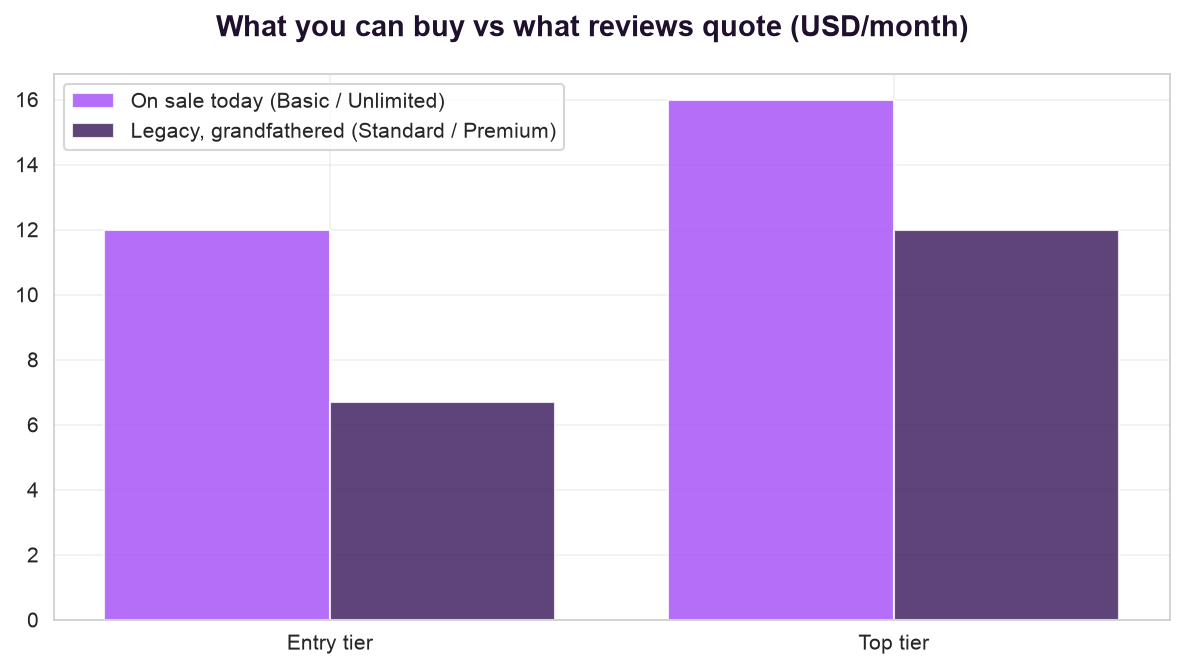
Nastia’s /pricing URL redirects to /app/membership, which renders behind a login — which is why every review quotes a different price. The plan table is, however, served publicly as data by the site’s own application. Here is what it held on 19 September 2026, filtered to what a new subscriber can buy:
| Plan | Monthly | Annual (one charge) | Effective/mo | Daily tokens | Companions |
|---|---|---|---|---|---|
| Free | $0 | — | — | allowance only | 1 |
| Basic | $11.99 | $87.95 | $7.33 | 200 | 2 |
| Unlimited | $15.99 | $99.95 | $8.33 | 400 | 5 |
The records also carry a pictures value of 600 on Basic and 2,000 on Unlimited. No reset period is stated in the data, so treat those as an image allowance of unconfirmed cadence, not a monthly cap.
The $6.69 that half the internet quotes is a legacy price you cannot buy. The same table still holds an older generation — “Standard” at $6.69/month or $49.99/year, “Premium” at $11.99/month or $87.63/year — sold through older processors and now reserved for existing subscribers, with a grandfathering expiry of 31 July 2027. Reviews quoting $6.69 aren’t lying; they are quoting a price that is closed to you and has an end date for the people who still have it.
Two details worth having. The legacy Premium allowed 10 companions; the current Unlimited, at $15.99, allows 5 — the newer, dearer tier permits fewer companions than the one it replaced. And the monthly bonus-token grant reads 3,000 on some payment-provider records and 100 on others for the same named plan. The vendor’s own table disagrees with itself, which is a fair summary of the whole situation.
Our AI companion subscription breakdown has the arithmetic across the category, and free AI girlfriend apps covers what you get for nothing.
The Token System: What Actually Costs What
A subscription does not buy unlimited everything. Tokens sit on top, and that is where the “expensive for what it delivers” complaint comes from. From the developer’s own public changelog — the community’s token guide is linked for further reading, not quoted:
- Sending an image to your companion: 10 tokens, and rerolls and “elaborate” cost 1 token (changelog, 2 March 2025).
- Grandfathered Early Standard and Premium members — memberships bought before February 2025 — get unlimited messages, “no tokens are taken when your companion replies,” per that same entry. Which means everyone else is paying per reply.
- Generating images is reported at roughly 10–20 tokens each, and top-up packs at 1,000 tokens for $2.99. Neither figure comes from Nastia; both are third-party and community numbers, so treat them as approximate.
Do the math on Basic — the arithmetic is ours. At 200 daily tokens and roughly 10–20 per generated image, a day’s allowance runs to ten or twenty images, or 200 messages, or some split. Comfortable for chat, tight the moment images enter it. An r/ChatbotRefugees thread titles itself “Nastia.ai doesn’t work and is too expensive”, and its excerpt makes the same point, adding that “only about 1/3 are usable” — one user’s estimate, not a measurement.
Credit where it’s due: Nastia operates a refund path for failed generations — the May 2025 changelog states that if a video takes over 12 hours or fails, “you’ll be able to refund it, similar to how you can refund images.” Most competitors don’t.
The Billing Complaints, and What the Price Table Explains
Trustpilot’s reviews are dominated by billing. Two recent ones, as users describe them: a September 2026 reviewer says an “agreed charge quadrupled” and support did not respond; a June 2026 reviewer reports being “charged 100 usd instead of 8 usd,” with “multiple attempts to contact for resolution went un answered.” These are user accounts on a review platform — not verified findings, and not a finding that anyone did anything wrong.
The second is worth sitting with, because the price table explains its shape exactly. Nastia’s annual plans are billed as one upfront charge — $87.95, $99.95, $87.63 — while presented in the familiar per-month framing of $7.33 or $8.33. A user who believes they are buying “$8 a month” and is charged $99.95 has, if the account is accurate, picked an annual plan that billed exactly as designed. Every subscription business shaped this way produces this complaint. It is a checkout-clarity problem, not necessarily a dishonesty one — and on a product that doesn’t publish prices where a buyer can read them first, a predictable one.
Two things compound it. The refund policy is explicit: “As the product is digital and immediately consumable, we operate a no-refund policy, unless required by law or in cases of technical error.” And cancellation, per the help page, runs through a “Danger Zone” section of membership settings — recoverable, but not one click.
If you subscribe: choose monthly first. The annual saving is real, and it is not worth finding out this way.
The Memory Problem — and the February 2026 Rebuild
Memory is the most-cited complaint about Nastia, and the most out-of-date one. The complaints are genuine and easy to find. The indexed excerpt of r/nastia’s “Memory” thread carries the complaint that “the ai forgets things that happened a few chats ago and also sometimes makes things up that never actually happened.” The excerpt of the older “Detail retention” is blunter: “She seems to forget everything, from the previous day.”
Here is what nearly every review quoting those threads leaves out. On 8 February 2026 the developer shipped a full rebuild of the memory system and said plainly why: “There was a v0 already in place but it wasn’t working as expected.”
The new behaviour, per the vendor: companions “are now fully able to retrieve messages from any past moment,” available to paid members only and only on the “Memory boosted” model, with high-confidence memory use flagged in the chat. More “improved chat AI and memory management” shipped with the May 2026 revamp.
So: a large share of the memory complaints in circulation predate the fix, the fix is gated behind a paid tier and a model toggle, and nobody has published a structured recall test of the post-February build — we haven’t run one either. If memory decides it for you, our guide to AI girlfriends that remember your conversations has the category picture, and Kindroid is built around persistence rather than patched toward it. One thing to know at any tier: clearing a conversation wipes it. The excerpt of “Clear coversation?” asks whether the AI forgets or merely loses the chat, and answers: “Yes, it erases everything.”
One Person Appears to Run This
One Reddit line visible in search results puts it flatly: Nastia is “run by literally one person” (r/ChatbotRefugees). We can’t confirm headcount — the French registry doesn’t disclose the employee band — but two first sources point the same way: the registry lists a single director and a single establishment, and the public changelog, ten entries across two years, is written throughout in the first person singular and signed “dbf.” “I have been coding, tinkering, fixing and creating new bugs.” “I went through 150 out of the 1800 Summer Survey responses.” “I am still battling with the group messages cutoff.”
That cuts both ways. The upside is in those same entries: a developer who names his own bugs, publishes known issues, admits a feature slipped from December to February, and reads 1,800 survey responses — more candour than most venture-funded competitors manage. The downside is structural and has nothing to do with him: a product holding your conversation history, your subscription and your payment relationship has a single point of failure. Price it in, especially before buying annually.
Is Nastia AI Safe?
Three questions that get muddled together.
As a company: a registered French SAS with a real address, a director on file, and compliance pages covering 18 U.S.C. 2257, DMCA, child safety, anti-trafficking and content removal — more legal scaffolding than most of this category carries.
As a data handler: the homepage states conversations are protected with “industry-standard encryption,” never sold, and deletable at any time. There is no claim of end-to-end encryption, so assume the operator can read conversations; images sent to companions are stated to be deleted after 30 days. For what to check before handing any companion app your chat history, see our AI girlfriend privacy guide.
As a product: uncensored adult software with no app-store gatekeeper, and age verification that is a documented page rather than a hard gate — the category norm, not a Nastia-specific failing.
What Nastia Gets Right
- The freedom is real. No jailbreaks, no filter roulette, no character deletions. If you left Character.AI or Replika over filtering, this is what Nastia actually wins on.
- Feature depth is unusual. Three image models (Unbound, Sakura, Velvet), video generation, custom voice design, group chats with turn control and mute, a six-axis personality graph, word biases — every one of those named in the changelog entries that shipped them. Against our tested NSFW AI image generators, few companion apps bundle this much.
- Development is visible and shipping, with known issues published rather than buried.
- Failed generations are refundable — documented, and rare in this niche.
- Existing subscribers are protected: legacy pricing honoured to 31 July 2027, not cancelled on notice.
What Nastia Gets Wrong
- Prices are invisible before signup.
/pricingbounces to a logged-in page. Every downstream problem here starts there. - The self-declared 4.8 doesn’t survive contact with visible evidence.
- Tokens on top of a $12–16 subscription. Images drain the allowance fast, and users report a low usable-output rate.
- Annual plans bill as one charge while marketed per month — the exact shape of the loudest Trustpilot complaint.
- The memory fix is paywalled, model-gated and unmeasured.
- As reviewers describe it, support responsiveness is a recurring problem — unanswered contacts appear across several recent Trustpilot reviews.
- Key-person risk. One director, one establishment, a changelog written in the first person singular.
Verdict: 6.5/10
Nastia is a more capable product than its Trustpilot score suggests, run with more visible honesty than its marketing, and sold through a checkout that creates its own worst reviews. Feature depth and creative freedom would score an 8 alone, and the development transparency is the best of anything we’ve reviewed here. The 1.5 points come off for pricing opacity, token economics that thin out a $15.99 subscription, a memory rebuild that is real but unproven and paywalled, and the discount you apply to anything billed annually by a one-director company.
Buy it if you want maximum creative freedom with deep image and video tooling — and subscribe monthly. Skip it if you need long-term memory with evidence behind it, responsive support, or the reassurance of a team you couldn’t fit in one room.
7 Nastia AI Alternatives Worth Considering in 2026
Which fits depends on what Nastia is failing at for you.
1. Kindroid — the structural answer to memory. Built around persistent long-term memory rather than rebuilt into it; Nastia’s own community names it as the memory benchmark. Smaller feature surface, no video.
2. Candy.AI — the polished commercial alternative. Better onboarding, a conventional checkout. Per Nastia’s own comparison page, Candy charges per image and per call minute — run the same token math first.
3. Bonza.Chat — uncensored AI chat with the price on the page. An NSFW AI chatbot with unlimited text messages on Pro, weekly credit top-ups and pricing published before you sign up. Honest trade: as advertised on its own pricing page it does text, images and voice — no video generation and no multi-companion group chat. If Nastia’s video pipeline or group chats are what you’re there for, Bonza will feel narrower.
4. Chai AI — the mobile-first, huge-library shape. Roughly 500,000 user-made characters and real app-store ratings you can check, at the cost of a 70-message free tier and ads.
5. SpicyChat — cheaper entry, deeper creation tools, and the closest like-for-like on breadth if $15.99 is what’s stopping you. More in our best AI sex chat round-up.
6. Janitor AI — free, if you’ll do the setup. Bring-your-own-model, no subscription, considerable configuration: your time instead of your money.
7. DreamGF — image-forward. If generated visuals rather than conversation are the point, this is built around them.
(Our Chai AI and SpicyChat reviews publish alongside this one, so those two links may 404 for a day or so.)
| Platform | Best for | Prices public? | Token economy | Memory |
|---|---|---|---|---|
| Nastia | Creative freedom, image + video | No | Yes | Rebuilt Feb 2026, unmeasured |
| Kindroid | One lasting companion | Yes | No | Strong by design |
| Candy.AI | Polish, easy start | Yes | Per-action | Medium |
| Bonza.Chat | Uncensored chat, clear pricing | Yes | Credits; text unlimited on Pro | Not tested here |
| Chai | Library and discovery | Store listing | Coins | Weak |
| SpicyChat | Cheap entry, creation tools | Yes | Tier-gated | Medium |
| Janitor AI | Free with setup | Free | No | Model-dependent |
| DreamGF | Generated visuals | Yes | Credits | Medium |
Broader shortlists: best AI girlfriend apps in 2026 and best AI chatbots for roleplay.
Frequently Asked Questions
How much does Nastia AI cost per month? From Nastia’s own plan table on 19 September 2026: Basic $11.99/month or $87.95/year, Unlimited $15.99/month or $99.95/year, plus a free tier. The $6.69 “Standard” price many reviews quote is a legacy plan new subscribers cannot buy, grandfathered until 31 July 2027.
Is Nastia AI’s 4.8 rating real? Nastia publishes it in its homepage structured data as 4.8 from 12,000 ratings, with no rating widget on the page and no source given. Trustpilot, the only independently moderated score, shows 2.1 from 16. Treat a 4.8 on any AI-companion site as marketing unless the reviews are visible.
Does Nastia AI remember conversations? Since 8 February 2026, yes — for paid members, on the “Memory boosted” model. The developer’s own post said the previous version “wasn’t working as expected,” which is why most complaints online predate the rebuild. No independent recall test of the current build exists.
How many tokens does a Nastia image cost? Sending an image to a companion costs 10 tokens, and a reroll or “elaborate” costs 1 token — both from Nastia’s own changelog. Generating an image is reported at 10–20 tokens by third-party reviews, which is not a Nastia figure and should be treated as approximate. Basic gives 200 daily tokens, Unlimited 400.
What are the best Nastia AI alternatives? Kindroid for memory, Candy.AI for polish, Bonza.Chat for pricing you can read before you pay, Chai for library size, SpicyChat for entry price, Janitor AI if you’d rather spend time than money, DreamGF if visuals are the point.