

If you have spent any time online recently, you have probably seen the word “gooning” in a meme, a comment thread, or a TikTok and wondered what it actually means. The honest answer is that it depends on who is using it, because the term has split into two very different meanings. This guide explains both clearly and calmly, looks at where the word came from, walks through the psychology in plain language, and gives you the straight facts on whether it is harmful, all without panic or judgment. This article is written for adults (18+) and keeps its language non-explicit throughout.
TL;DR
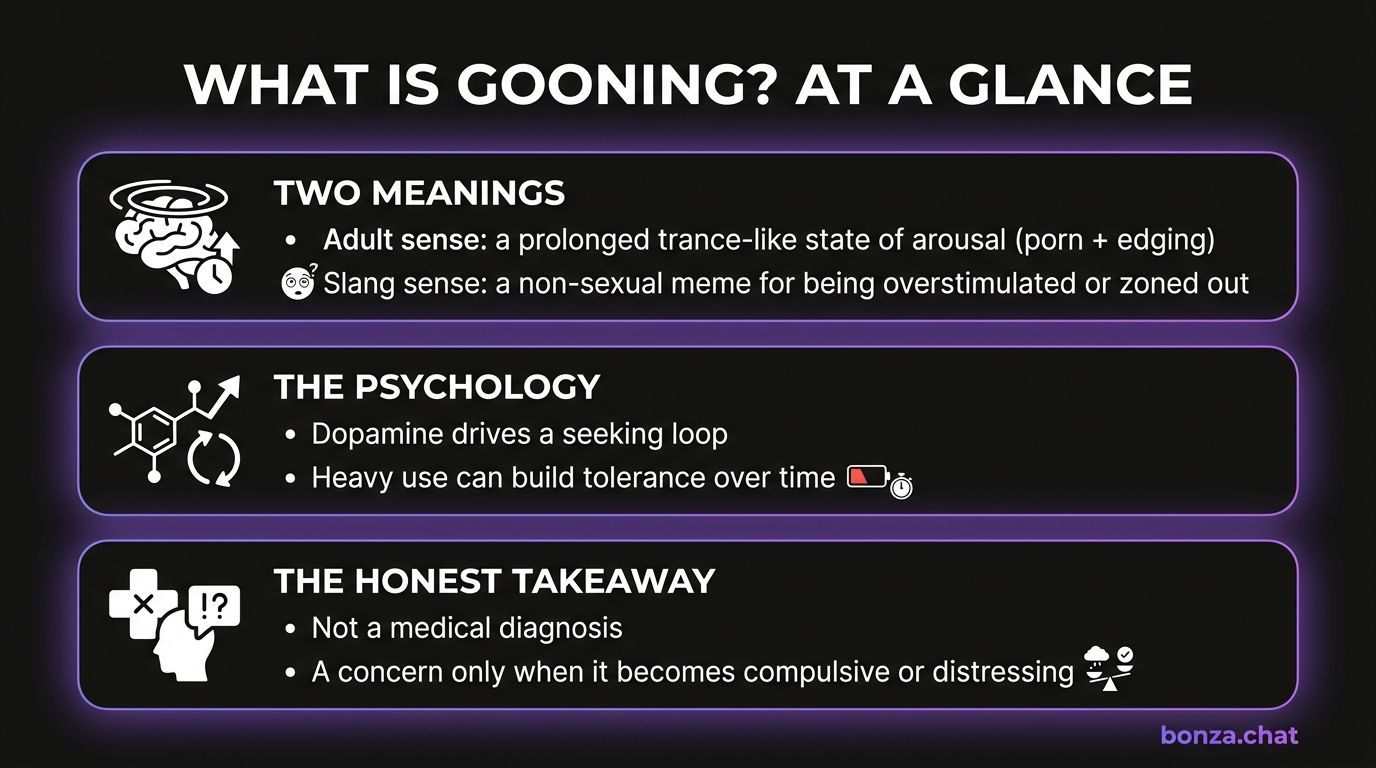
- Gooning has two meanings today. In its original adult sense it describes a prolonged, trance-like state of sexual arousal, usually involving extended porn use and edging (deliberately staying aroused without finishing).
- In Gen-Z and Gen-Alpha “brainrot” slang, it is often used loosely and non-sexually to joke about being overstimulated, zoned out, or obsessed with something online.
- It is internet slang, not a medical diagnosis. You will not find “gooning” in the DSM-5-TR.
- The psychology centers on dopamine and the brain’s reward system. Like many intense, repeatable behaviors, it can build tolerance over time.
- For most adults, occasional solo behavior is normal. It becomes a concern only when it turns compulsive, distressing, or starts interfering with daily life, relationships, sleep, or work.
- This piece is supportive, not alarmist. If you are worried about your own habits, that is worth taking seriously, and there are gentle, practical steps below.
What Does Gooning Mean?
At its root, gooning describes slipping into a deep, absorbed, almost trance-like headspace during sexual arousal. The defining feature is duration and immersion rather than release. People who use the term in its adult sense usually link it to extended viewing of pornography and to edging, which means staying highly aroused for a long stretch without reaching climax. The idea is to stay in the heightened “in-between” state, sometimes described as a flow state, for as long as possible.
That is the original meaning. The reason the word feels confusing in 2026 is that it has escaped its original community and picked up a second, much broader life online.
The two meanings, side by side
- The adult meaning: a prolonged, immersive state of sexual arousal, associated with porn and edging. This is the sense most health and psychology coverage refers to.
- The slang or meme meaning: a loose, often non-sexual exaggeration. Younger users may say they are “gooning” over a video game, a celebrity, a snack, or simply being so absorbed in their phone that they lose track of time. Here it is closer to “zoning out,” “obsessing,” or “rotting” than to anything explicit.
Because the same word covers both, context is everything. A comment under a gaming clip almost certainly means the playful version. The same word in an adult forum means the literal one.
Where Did the Term Come From?
Gooning started in adult online communities, where it was used to describe that drawn-out, blissed-out arousal state. From there it spread outward across Reddit, X (formerly Twitter), and certain Discord servers, and entries on sites like Know Your Meme helped document and popularize it.
What pushed it fully mainstream was Gen-Z and Gen-Alpha “brainrot” humor, the self-aware online culture built around memes about overstimulation, short attention spans, and being terminally online. In that world, words get stripped of their original heat and reused as exaggerated jokes. “Gooning” became shorthand for being comically over-absorbed in anything. That drift is exactly why a parent, a teenager, and an adult forum user can each hear the word and picture something completely different.
The Psychology Behind Gooning
You do not need a neuroscience degree to understand why this behavior can become absorbing. It comes down to the brain’s reward system, and to one chemical in particular.
Dopamine and the reward loop
Sexual arousal and novel, intense stimulation both trigger the release of dopamine, a neurotransmitter tied to motivation, anticipation, and reward. Dopamine is not “the pleasure chemical” exactly; it is more like the “wanting” and “seeking” chemical. It is what makes you reach for more. A prolonged, high-intensity arousal state, sustained by an endless scroll of novel content, can keep that seeking loop running far longer than a typical experience would.
Tolerance and desensitization
Here is the honest part. When the brain is exposed to unusually high, repeated levels of stimulation, it adapts to protect itself. Over time, that can mean a person needs more intensity, more novelty, or more time to reach the same feeling. This pattern of rising tolerance is well documented across many repeatable, rewarding behaviors, and it is the mechanism most clinicians point to when they discuss the potential downsides of heavy, habitual use.
A note on younger brains
Most experts who raise concerns focus on adolescents specifically. The teenage brain is still developing, particularly the regions that govern impulse control and long-term planning, which is part of why clinicians treat early, heavy exposure to intense sexual content more cautiously than the same behavior in adults. This article is for adults, but it is worth naming clearly: the louder warnings in the news are usually about teens, not grown adults making informed choices.
Is Gooning Bad? An Honest, Non-Judgmental Look
This is the question most people actually came to answer, so here is a straight, balanced response rather than a scare story or a shrug.
For most adults, solo sexual behavior, including exploring arousal states, is a normal and private part of life. Exploring what you enjoy is not inherently unhealthy, and feeling guilt about ordinary behavior can do its own quiet harm. The slang, meme-y version of “gooning” is usually just a joke and carries no health weight at all.
The picture changes when a behavior stops being a choice and starts being a compulsion. Clinicians do recognize a real condition called Compulsive Sexual Behavior Disorder, included in the ICD-11, where sexual behavior becomes difficult to control and causes genuine distress or disruption. The key word is compulsive. A behavior is worth a second look when it:
- Crowds out sleep, work, study, or time with people you care about.
- Feels hard to stop even when you want to, or you keep doing it longer than you intended.
- Leaves you feeling distressed, ashamed, numb, or low afterward, on a regular basis.
- Gradually needs more time or more extreme content to feel like “enough.”
- Starts replacing real-world connection and intimacy rather than complementing it.
If none of that sounds like you, there is genuinely nothing here to panic about. If some of it does, that is not a moral failing, and noticing it is the hard part already done.
Is Gooning Healthy? Where Moderation Comes In
”Healthy” is less about the label and more about the relationship you have with the behavior. The same activity can sit comfortably in one person’s life and quietly take over another’s. A few gentle, practical guideposts:
- Watch the clock, not the calendar. A single long session is not the issue. Frequently losing hours you meant to spend elsewhere is the signal worth noticing.
- Check how you feel afterward. Content and relaxed is very different from drained, foggy, or down. Your own after-feeling is reliable data.
- Keep variety in your life. Problems tend to grow when one source of reward starts pushing out exercise, hobbies, friends, and rest. Balance is the real protective factor.
- Mind escalation. Needing steadily more intensity to feel anything is the clearest cue to ease off and reset.
- Take honest breaks. If stopping for a week feels unexpectedly hard, that information is worth sitting with, not judging.
If a habit is causing you real distress or you cannot rein it in on your own, talking to a doctor or a therapist who works with sexual health is a sensible, ordinary step. Support exists, it works, and reaching for it is a sign of self-respect, not weakness.
A Healthier Way to Explore: Connection Over Compulsion
One useful reframe is to shift from passive overstimulation toward something more interactive and human-feeling. A lot of what makes compulsive scrolling hollow is that it is one-directional: you consume, and nothing meets you back. Intimacy, even playful or fantasy intimacy, feels different when there is actual back-and-forth, attention, and a sense of being responded to.
This is one reason some adults prefer chatting with an AI girlfriend or companion over endless passive feeds. A conversation-based experience is responsive and personal: it remembers you, talks back, and is built around connection and pacing rather than a bottomless scroll engineered to keep you hooked. Used thoughtfully, an AI companion you can actually talk to can be a calmer, more present, more intentional way to explore desire as a consenting adult, with you setting the pace. As with anything, the healthiest version is the one that adds to your life and stays in proportion, rather than quietly replacing rest, people, and the rest of who you are.
Frequently Asked Questions
What does gooning mean? Gooning has two meanings. In its original adult sense it describes a prolonged, trance-like state of sexual arousal, usually involving extended porn use and edging (staying aroused without finishing). In newer Gen-Z and Gen-Alpha slang it is often used loosely and non-sexually to joke about being overstimulated, zoned out, or obsessed with something online. Context decides which one is meant.
Is gooning bad for you? Not inherently. For most adults, private solo behavior is normal, and the meme version is just a joke. It becomes a concern only when it turns compulsive: when it is hard to stop, causes distress, or starts interfering with sleep, work, relationships, or daily life. At that point it is worth addressing, ideally with a professional.
Is gooning a real medical condition? No. “Gooning” is internet slang, not a clinical diagnosis, and it does not appear in the DSM-5-TR. That said, clinicians do recognize Compulsive Sexual Behavior Disorder in the ICD-11 for cases where sexual behavior becomes genuinely uncontrollable and distressing. The slang term and the diagnosis are not the same thing.
How do I cut back if it feels compulsive? Start small and without shame. Notice your patterns, set gentle time boundaries, add other rewarding activities back into your days, and pay attention to how you feel afterward. If stopping feels unexpectedly hard or it is causing you real distress, talk to a doctor or a therapist who specializes in sexual health. Support is normal and effective.
Why is “gooning” suddenly everywhere? The word jumped from adult communities into mainstream “brainrot” meme culture, where younger users repurposed it as an exaggerated, mostly non-sexual joke about being overstimulated or obsessed. That crossover, spread across TikTok, Reddit, and X, is why the term feels both inescapable and confusing in 2026.