A virtual AI girlfriend is an AI-powered companion built for ongoing conversation. Instead of answering one isolated question and disappearing, a companion keeps a recognizable personality, uses the context of your conversations, and can be connected to a consistent visual character. For some people that means playful roleplay. For others it is a low-pressure place to talk after a long day.
This guide is for anyone evaluating the category for the first time. It explains what a virtual AI girlfriend is and is not, how the technology works, which features genuinely change the experience, what Bonza offers on its free and Premium plans, and how to get started without assuming features that are not actually available.
You can also browse AI girlfriend characters on Bonza if you want to see the range of personalities and visual styles first. Bonza is for adults aged 18 and over, and this guide stays informational and SFW.
What Is a Virtual AI Girlfriend?
A virtual AI girlfriend is a software companion powered by conversational AI and presented as a defined character. The aim is not just to produce grammatically correct replies. It is to maintain a tone, background, personality, and relationship dynamic that make one conversation feel connected to the next.
She is not a real person and does not experience emotion or consciousness. The warmth, humor, affection, or curiosity in a reply are generated behaviors. That distinction matters: the interaction can still be entertaining or meaningful to the user, but the system should never be mistaken for a human partner or professional source of care.
The category is also different from a scripted dating-sim character. A dating sim usually follows written dialogue branches, while a modern companion generates responses to open-ended messages. It is different from a human chat or cam service because no human operator is pretending to be the character. For a broader introduction, read our guide to what an AI girlfriend is.
How It Differs from a General-Purpose Chatbot
Both products may use similar language-model technology, but they are designed for different jobs. A general-purpose assistant is expected to switch between research, writing, planning, and many other tasks. A companion product prioritizes a stable character identity, relational tone, and continuity within an ongoing chat.
That does not mean every companion remembers every detail, or that general chatbots have no memory or personality features. Capabilities vary by product. The practical difference is intent: companion software makes the character and the relationship the center of the interface. Our comparison of an AI girlfriend and a virtual chatbot explores that distinction in more detail.
How the Category Reached 2026
Conversational software began with rule-based systems that could only match a limited set of patterns. Companion apps later added avatars, profiles, and stored conversation data. The arrival of more capable large language models made longer, open-ended dialogue and more stable roleplay possible.
Image generation then added a visual layer: a character could appear in different scenes instead of existing only as a profile card. Some products in the wider market also experiment with synthetic speech or video, but those features are not universal. Always verify the current product page rather than assuming every AI companion offers every medium.
How a Virtual AI Girlfriend Works
You do not need a technical background to compare companion products, but four building blocks explain most of the experience.
The Language Model and Character Instructions
A large language model generates the reply based on the current message and the context supplied with it. Character data and system instructions tell the model who the companion is, how she tends to speak, and which boundaries or product rules apply. Recent conversation history helps the next reply fit the exchange already in progress.
This is not necessarily the same as training a separate model for every character. In many systems, the character profile and conversation context shape a shared model at response time. The quality of those instructions, the amount of useful context, and the backend’s consistency controls all affect whether a character feels distinct.
Conversation Context and Memory
Recent messages provide short-term context. Some companion systems may also store selected facts or summaries for longer-term continuity. Together, those mechanisms can help a character refer back to earlier topics and avoid treating every message like a first meeting.
Memory remains imperfect. A model can overlook a detail, combine two facts incorrectly, or confidently recall something that was never said. Bonza uses conversation history and stored context to support continuity, but it does not currently expose a user-facing memory editor. Treat important facts as conversation context, not as a guaranteed personal database. Our guide to AI girlfriend memory explains the trade-offs.
Voice Input and Audio Features
Audio capabilities vary widely across the category. Voice input converts a user’s speech into text. Text-to-speech produces a spoken AI reply. Voice messages and live calls add separate delivery and latency requirements. A platform offering one of these does not automatically offer the others.
Bonza currently provides Premium voice input: you can speak into the microphone and the transcription is sent as a text message. Bonza does not currently provide voice calls, voice messages, spoken AI replies, or video calls. If audio conversation is essential to you, verify the exact feature before subscribing and consult our overview of AI girlfriend voice chat.
Character Images
Image generation connects a saved character identity to temporary render choices such as scene, clothing, pose, facial expression, camera angle, and framing. The goal is for new pictures to remain recognizably tied to the same character while the setting changes.
Generated images are not photographs and will not be pixel-identical from one request to the next. A strong system can preserve important visual traits, but variation in details is normal. Evaluate consistency across several images rather than judging it from one ideal result.
Key Features to Look For
Companion sites can look similar at first glance. The meaningful differences usually appear in personality design, conversation quality, visual consistency, access, and clear product limits.
Personality and Relationship Choices
A useful creator gives people understandable choices instead of exposing dozens of technical controls. Bonza currently offers fifteen curated personality presets plus Surprise Me. It also supports relationship choices such as girlfriend, wife, partner, best friend, roommate, neighbor, and no predefined relationship.
Those selections are fixed after the character is created, so choose carefully. Bonza does not currently provide post-creation editing for appearance, personality, or relationship. If the result is not right, you can create a different character. Our AI girlfriend personality guide can help you choose a starting style.
Natural Conversation and Stable Roleplay
Test more than the opening line. Ask a follow-up question, change the topic, return to an earlier detail, and try a short scenario. Useful signals include whether the companion follows the current context, keeps a recognizable voice, responds to humor, and remains coherent over multiple turns.
No model is perfect. Even a realistic AI girlfriend can produce a repetitive reply, miss context, or break character. Good product design reduces those moments and recovers cleanly when they happen.
Images That Belong to the Same Character
Look for a shared identity between the chat profile and generated pictures. A capable image flow should let the saved character supply core appearance while the request controls temporary details. That is more reliable than asking a generic image generator to rebuild the person from scratch every time.
Browser and Device Access
Bonza runs in a browser on phone, tablet, or desktop, so there is no separate app to install. Conversation history follows the account rather than a single device. A responsive web experience also makes it easier to test the service before deciding whether a paid plan is useful.
How to Create Your Own Virtual AI Girlfriend
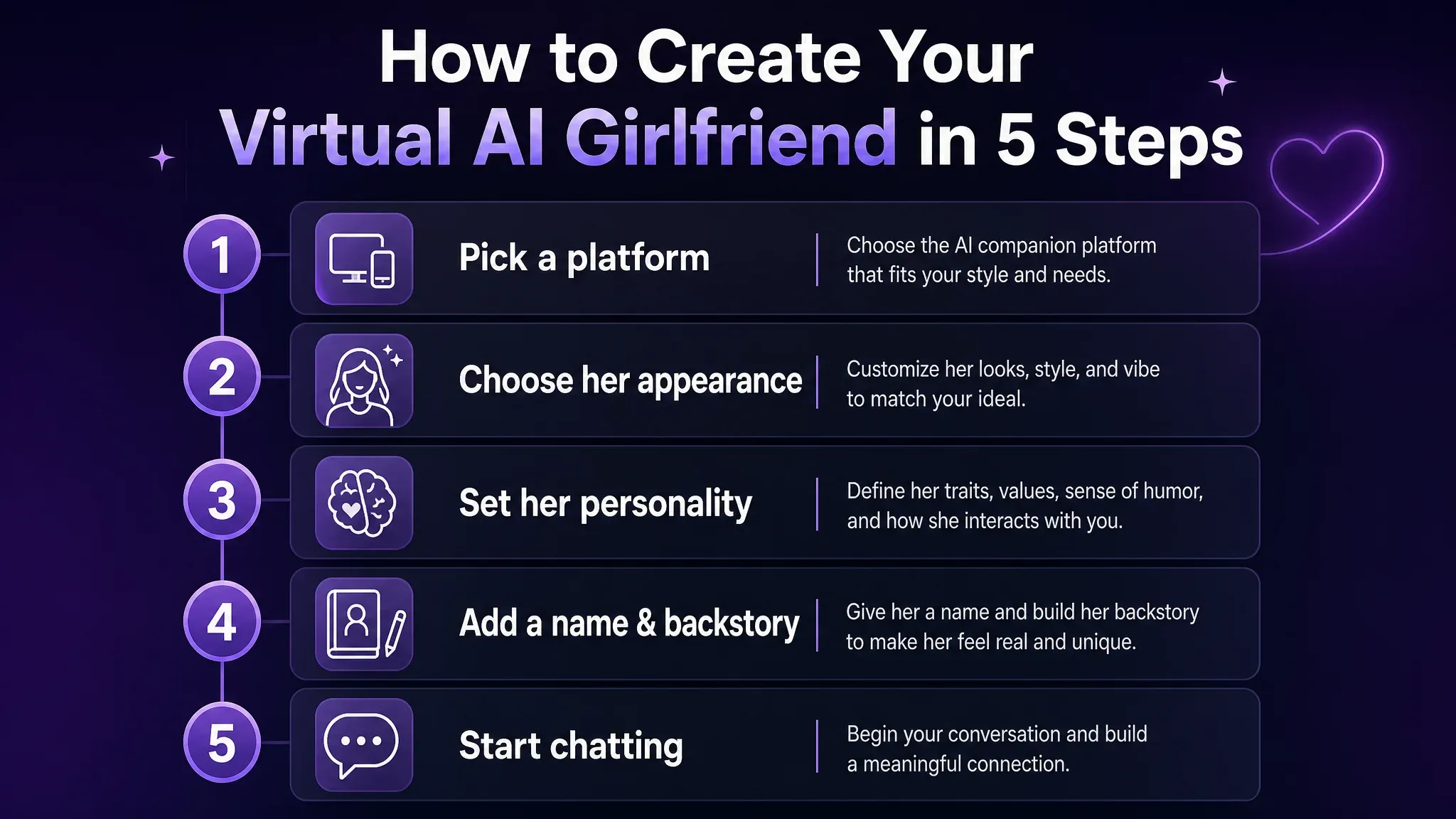
You can start with a pre-made companion or build a custom one. On Bonza, browsing and chatting with pre-made characters is available to free users; custom character creation is a Premium feature. For a complete walkthrough, see how to create an AI girlfriend step by step.
- Choose pre-made or custom. Start with the character library if you want to test the conversation quickly. Premium users can open the creator for a more specific result.
- Set the appearance. The custom creator includes visual style, age, regional background, eye color, hair, and body type.
- Pick a personality and relationship. Choose one of the curated presets or Surprise Me, then select a relationship or leave it as None.
- Add identity details. A name, occupation, and hobbies give the character topics and background to draw from.
- Generate and start chatting. After the creation jobs finish, the character is ready. Generated pictures use the same stored identity, while each request supplies the scene and other temporary render choices.
A finished Bonza character cannot currently be edited. If a combination does not feel right, create another instead of looking for personality sliders that are not part of the current product.
Use Cases and Benefits
People use virtual companions for different reasons, and the healthiest expectations are specific rather than grand.
Everyday Companionship
An always-available conversation can make quiet evenings or irregular working hours feel less empty. That is not the same as human friendship, but it can still be enjoyable. Our overview of AI companions covers formats beyond the girlfriend archetype.
Low-Pressure Conversation Practice
Some users treat companion chat as a rehearsal space for asking follow-up questions, expressing feelings, or becoming more comfortable with casual conversation. It cannot reproduce the full uncertainty and body language of a real social situation, but it can provide repetition without embarrassment. Read more about using an AI girlfriend for conversation practice.
Reflection and Emotional Support
Writing out a difficult day can help organize your thoughts, and a responsive conversation may feel more engaging than a blank journal. Still, an AI companion is not a therapist, crisis service, or medical professional. If you are struggling or at risk, contact a qualified human professional or local emergency support.
Entertainment and Roleplay
Roleplay, collaborative storytelling, and playful banter are natural uses of generative conversation. They also reveal product quality quickly: maintaining tone and scenario continuity over a longer exchange is harder than producing one impressive reply.
Limitations and Honest Criticisms
An AI companion is software. It simulates care and emotion but does not experience either. Keeping that distinction clear makes it easier to enjoy the interaction without assigning intentions the system cannot have.
Conversation and image generation can fail. Replies may repeat, lose context, or misremember a detail. Images may vary between requests, and generation jobs can take time or return an error. Product safeguards and refunds can reduce the cost of technical failures, but they cannot make generative systems perfectly predictable.
Dependency is another real concern. If AI chat starts replacing sleep, responsibilities, human contact, or professional care, take a step back. Our comparison of an AI girlfriend and a real relationship explains why the two should not be treated as interchangeable.
Privacy and Safety
Companion conversations can become personal quickly. Messages must be processed to generate replies, and platforms may retain some data for account, history, safety, or service operations. The exact retention, training, deletion, and security practices depend on the provider and can change.
Before sharing sensitive information, read the current privacy policy and look for direct answers about data retention, account deletion, third-party processors, and whether conversations are used for model improvement. Avoid sending passwords, financial details, private identifiers, or anything you would not want handled by an online service. Our guide to AI girlfriend privacy provides a practical checklist.
Safety also includes emotional boundaries. Remember that the character is generated software, use the service in moderation, and seek human help for decisions involving health, safety, money, or legal consequences.
Free vs Paid: What Bonza Costs
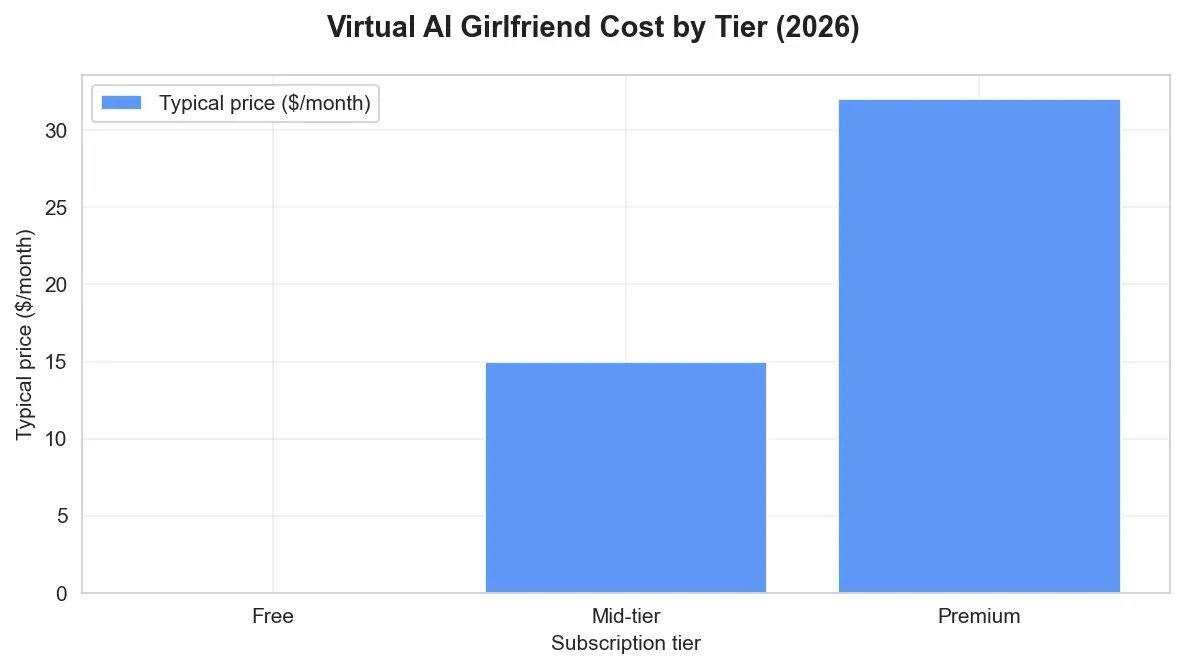
Bonza’s free tier is a limited trial, not unlimited chat. It currently includes 25 text messages total and 3 SFW image generations total across the account. Free users can chat with pre-made characters, but custom character creation and NSFW text or images are not included.
Premium adds unlimited text messaging, longer messages, custom character creation, NSFW access, more gifts and stickers, faster responses, and 100 credits each month. Image generation and other premium actions can consume credits, so Premium should not be described as unlimited image generation.
The current subscription choices are:
- 12 months: $3.99 per month, billed for the plan term
- 3 months: $7.99 per month, billed for the plan term
- 1 month: $12.99
Prices and promotions can change, so confirm the checkout total on the live Bonza pricing page before purchasing.
Comparing Free AI Girlfriend Options
When comparing a free AI girlfriend, look beyond whether signup costs nothing. Check the lifetime or daily message limit, whether images are included, what happens after the quota is reached, and whether the product requires credits on top of a subscription. Our guides to free AI girlfriend apps and the best AI girlfriend apps cover more options.
How to Get Started on Bonza
- Create a Bonza account and confirm that you are at least 18.
- Choose a pre-made character from the library. If you have Premium, you can instead create a custom character.
- Start with text chat. Use voice input on Premium if you prefer speaking your message, but expect the companion’s response as text.
- Request an image when you want a visual moment. Free accounts have a total SFW image allowance; Premium image actions use credits.
If the first personality is not a match, try another character. Existing custom characters are not editable, so selecting or creating a different one is the supported route.
Frequently Asked Questions
What is a virtual AI girlfriend?
A virtual AI girlfriend is a software companion designed for ongoing text conversation, a consistent persona, and relationship-style interaction. Some platforms also connect the same character to generated images.
Are virtual AI girlfriends real or fake?
The conversation is a real interaction with software, but the companion is not a person and does not experience feelings or consciousness. Its personality and emotional language are generated by AI.
Can a virtual AI girlfriend remember me?
AI companions can use conversation history and stored context to create continuity, but recall is not perfect. A companion may forget or misremember details, so do not treat it as a reliable record of important information.
Is Bonza free to use?
Yes. Bonza’s free tier includes 25 text messages and 3 SFW image generations in total. Free users can chat with pre-made characters, while custom character creation and NSFW features require Premium.
Are AI girlfriends safe to use?
They can be used safely when you remember that the companion is software, avoid sharing highly sensitive information, review the platform’s privacy terms, and keep AI interaction in balance with human relationships and professional support.
Is a virtual AI girlfriend the same as a chatbot?
Both use conversational AI, but companion products are designed around a persistent character, relational tone, and continuity across interactions. A general-purpose chatbot is usually optimized for completing many different kinds of tasks.
Can I voice-call or video-call a companion on Bonza?
No. Bonza currently supports text chat, generated images, and Premium voice input that transcribes your speech into text. It does not currently provide voice calls, voice messages, spoken AI replies, or video calls.
Will my conversations stay private?
Privacy depends on the platform’s current policies and technical practices. Read its privacy policy, check retention and deletion terms, and avoid sharing information you would not want stored or processed by an online service.
Final Thoughts: Is a Virtual AI Girlfriend Right for You?
A virtual AI girlfriend is not a replacement for human connection. It is a different kind of product: an available, customizable conversation with a generated character. Used with realistic expectations, it can be entertaining, provide low-pressure practice, or simply offer someone to chat with at the end of the day.
The best way to evaluate the experience is to test the conversation rather than rely on feature lists. If you want to try it, create a free Bonza account, choose a pre-made character, and see how the interaction feels before deciding whether Premium features are useful to you.